by Rob Penfold | May 4, 2026 | News
Dear HLA members,
Thanks to everyone who took the time to complete the recent HLA member survey. We received 55 responses, and the feedback clearly demonstrates strong engagement, generosity of insight, and deep commitment to the health librarianship profession.
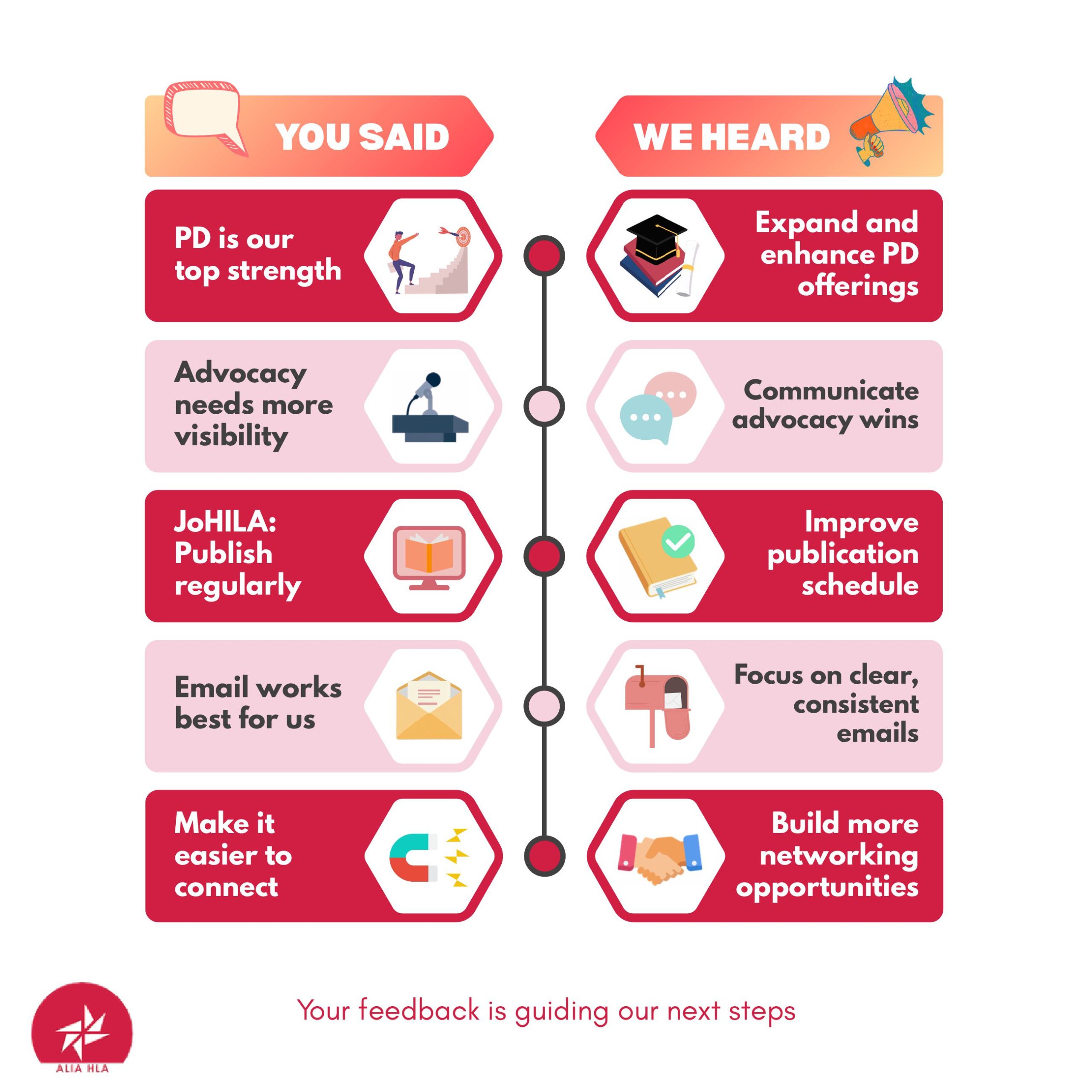
Below is a summary of the key themes that emerged across the survey responses (image followed by text further below) 🔽


Strong overall support for HLA
Members consistently expressed high satisfaction with HLA’s role and value, particularly recognising the impact of a volunteer‑run organisation that delivers far more than might be expected with limited resources. Many responses highlighted the collegiality, responsiveness and expertise within HLA, with several noting that HLA is a significant reason they maintain ALIA membership.
Professional development is HLA’s strongest offering
Professional development was clearly identified as HLA’s standout strength. Members value the accessibility of online and lunchtime sessions, consistency across the year, and the peer‑led, practice‑focused approach. There is strong interest in continued PD relating to AI in health librarianship, searching and databases, technical skills, teaching roles, and research, along with support for short, practical formats and clearer progression from beginner to advanced levels.
Advocacy matters, visibility matters more
There is strong support for HLA’s advocacy role, especially in the context of funding constraints, restructuring and technological change. At the same time, respondents would welcome clearer communication about advocacy activity and outcomes, as well as practical, evidence‑based messages that can be used locally with senior decision‑makers.
Communications, publishing and the website
Email was consistently identified as the most effective communication channel. JoHILA is highly valued as both an advocacy and evidence‑building publication, though concerns were raised about publication consistency and visibility. Website content is seen as relevant and high quality, but members noted ongoing challenges with findability and navigation.
Inclusion, connection and future focus
Across the 55 responses, there was a strong desire for greater connection beyond formal PD, particularly for early‑career librarians and those working in solo or changing roles. Members also expressed clear appetite for HLA leadership in research and future‑focused work, especially around AI, integrity, and workforce change.
What you can expect next – early actions in response to your feedback
In response to what you told us, the HLA Executive has identified several immediate, practical actions to improve consistency, visibility and access to what already works well:
Communications, publishing and the website
JoHILA will move to a clearer and more consistent publishing schedule, with a target of three issues per year.
Publication timeframes and submission deadlines will be clearly published on the HLA website to improve transparency and planning.
A Google search box has now been added to the HLA website to support better findability of existing content, resources and advocacy materials.
Professional development
We will investigate a broader range of PD formats and topics, with an emphasis on practical, skills‑based sessions.
This will include clearer differentiation between beginner and advanced sessions, as well as options that support librarians at different career stages and in diverse roles.
Advocacy and visibility
We will more actively share advocacy activity and wins on the HLA website, including examples that members can use locally.
Advocacy updates will also be regularly incorporated into HLA member emails, so this work is more visible and easier to follow.
The overarching message from the survey was clear: members do not want HLA to do more. they want clearer signals, better visibility, greater consistency, and easier pathways into what already works well.
The HLA Executive will use this feedback to guide priorities and practical next steps, and we will continue to update members on actions taken in response to what you told us.
Thank you again for your time, honesty, and continued support of HLA.
Regards, HLA Executive
by Rob Penfold | Jul 2, 2026 | Events
Event Description
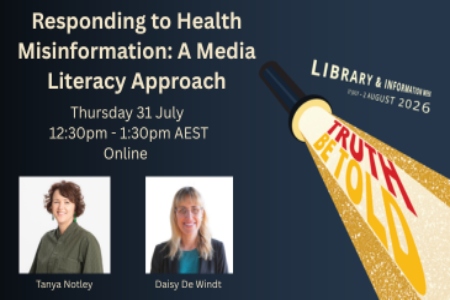
While the internet provides considerable opportunities to access and share information, it also increases people’s exposure to misinformation. It is increasingly difficult to determine the trustworthiness of the media in our environment, which is of particular concern in the field of health. Evidence suggests health misinformation is having real-world widespread negative consequences.
This talk explores how a media literacy approach can help organisations, community groups and citizens respond to the challenge that misinformation poses. It draws on findings from a 3-year research study that partnered with four public cultural institutions: Australian Library and Information Association, ABC Education, Museum of Australia Democracy and the National Film and Sound Archive of Australia.
Presenters
Tanya Notley & Daisy De Windt
Bios
Tanya Notley is Professor of Digital Media in the School of Arts and a member of the Institute for Culture and Society. Tanya currently leads a national project that uses media literacy to address online misinformation through a collaboration with national public cultural institutions. Tanya leads the Advancing Media Literacy Program at WSU and is a founding member of Australian Media Literacy Alliance (AMLA).
Daisy De Windt has over 20 years’ experience working in research, medical education and health communications, including over 10 years producing engaging, evidence-based media for a range of audiences. She has completed degrees in Psychology, Health Law, Biomedical Science and Business and is a PhD candidate at Western Sydney University.
When
Thursday, 30 July 2026
12:30pm – 1:30pm AEST
Where
Online webinar Zoom – a link will be sent the day prior.
This event will be recorded and sent to attendees following the event.
Cost
ALIA Members – FREE (another reason to consider HLA Membership)
Non-Members – $22
Register
Register