This session explores the diverse and evolving roles health librarians play in Human Research Ethics Committees (HRECs) from formal committee positions to advisory, governance, and quality‑improvement functions.
Speakers will share real‑world perspectives on how librarian expertise strengthens ethical research practice and supports researchers across health and academic settings.
Daniel McDonald – Librarian, Darling Downs Health, Editor, JoHILA.
Kathryn Ritchie – Health Sciences Librarian, Central Queensland Hospital and Health Service. Secretary (Interim) CQHHS HREC.
Nikki May – Manager Library Projects and Planning, SA Health Library, Co-Convenor AEBPLI.
Joanna (Asia) Dziedzic – Research Data Librarian, Charles Darwin University.
DanielMcDonald has been librarian for Darling Downs Health since 2006. He has twice received the HLA digital innovation award, and in 2021 was named Queensland Library Achiever of the year. He is editor of the Journal of Health Information and Libraries Australasia, and host of the podcast Shoosh. He is currently acting chair of the Darling Downs Health Human Research Ethics Committee.
Last Friday he conceded four goals 😄 at Friday night football ⚽, but did get his hands to three of them. He yells at his kids too much, but also gives them chocolate milk 🍫. The two may be linked.
Kathryn Ritchie is a Health Librarian at Central Queensland Hospital and Health Service (CQHHS) in Rockhampton, committee member of the Australasian Evidence Based Practice Librarians’ Institute (AEBPLI), UQ Research Fellow, and CQ HREC Secretariat/Co-ordinator. Kathryn blends her clinical insight and research expertise to empower healthcare professionals. Kathryn is dedicated to advancing evidence-based practice, supporting clinicians in discovering and applying the best available evidence through the design and execution of systematic type search strategies, and guidance in the development of quality and research projects.
Nikki May is a Library Manager with the SA Health Library Service (SAHLS). She is responsible for the Research, Reference, Training, and Outreach library portfolios. As a part of the SAHLS management team Nikki’s role is currently focused primarily on strategic planning and service improvement projects. Nikki is also co-convenor of the Australasian Evidence-Based Practice Librarians’ Institute.
JoannaDziedzic is Research Data Librarian at Charles Darwin University, where she leads research data management services and provides expert advice to the Human Research Ethics Committee as a committee member. Joanna has worked in academic libraries across Australia and Europe, with experience in scholarly communication, repositories, copyright, and research data. Her interests include First Nations data governance and data management planning
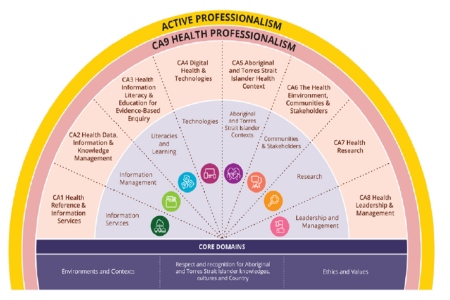
🏄 ALIA Competencies:
CA6 – The health environment, communities and stakeholders
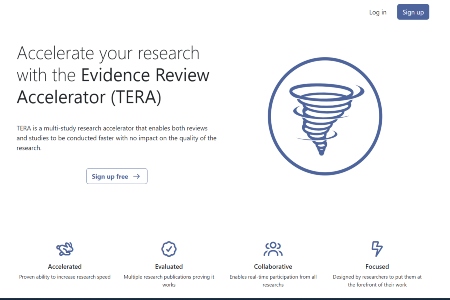
Justin Clark is running a free 1 hour webinar on TERA Tools
The webinar will cover live demonstrations of all the tools available in the Evidence Review Accelerator (TERA) to help you improve your searching skills & options
Recordings will be available after the event if you cannot attend & also on Tera Tools YouTube
If you would like to refresh your memory or acquaint yourself with any of the tools – so you can ask Justin the really difficult questions he loves – then a selection of TERA videos are available below ⬇️
You can also login or sign up on the TERA Tools home page to play with the tools on offer
Healthcare decision-making and research is influenced by our regulatory environment which includes legislation, case law and legal commentary. Understanding how to find and navigate this legal information is an important knowledge for librarians. Join us for an introduction to Australian legal information resources tailored for health librarians.
This one-hour session will cover:
• Key websites for legislation and parliamentary materials • Accessing case law including practical search tips • Legal commentary, reform papers and analysis • Sources of information for intellectual property and patents • Guides for citing legal information
Alice Anderson is Head of Library & Knowledge Services at Monash Health, where she leads a comprehensive service encompassing research skills education, research support services, clinical information resources, digital services and five library locations across south-east Melbourne. She is responsible for the delivery of a research training framework that supports clinicians, researchers, students, and health professionals to build evidence-based practice and research capability.
Alice has extensive experience across health, legal and corporate library sectors which has included managing the library at Lander & Rogers and librarian roles with the Law Institute of Victoria and TABCORP. Alice currently serves as Convenor of GratisNet, Australia’s national health library resource sharing network.
C1: Health reference and information services C2: Health data, information and knowledge management C3: Health information literacy and educating for evidence-based inquiry C6: The health environment, communities and stakeholders
Quite interesting between the dog-fights, gin-shops, “money wrung from the reluctant grasp of famishing workmen and workwomen”, “plague spots” and “cause of the spread of disease in all towns through the circulation of the books in infected houses”. Who knew they were so contentious
In case you missed it. Gratisnet can now autopopulate citation details for article requests – just paste in the DOI in the DOI field and then tab away – works for all articles that are in doi.org
“Compared with previous LLM applications that addressed isolated subtasks or provided free-text advice, these results suggest that an EHR-integrated artificial intelligence agent can turn clinical intent into structured, actionable EHR operations, possibly making it a more effective decision-support partner for physicians”
Recently I had to do a search to see if a particular tool had been validated for use in nursing / midwifery settings
I did a thorough search using several databases as well as looking at all the articles citing the original paper in question
In the end, I was quite confident that the tool hadn’t been used in these settings (which is what the researcher was hoping to hear as they want to validate it for those settings)
Out of interest, I thought I’d put the same question to several AI’s (largely dictated by the ones that haven’t been blocked at work & those that offer a free tier search)
I wasn’t expecting that much as the original paper had been cited around 150 times and many of the articles contained words or phrases related to validation (“we used a validated instrument” etc) as well as being used in nursing and midwifery settings (but not validated for such use) so that you could imagine the AI’s would quite easily be misled & discombobulated, and so conflate this to mean that it had actually been validated in those settings.
The simple question used with each AI tool was:
The Research Capacity and Culture (RCC) tool was developed in 2012 (DOI: 10.1071/PY10081). Are there any articles which subsequently describe specifically validating this RCC tool for use with nurses or midwives?
Rather to my surprise, I found that not one of the eight AI’s made this error, and all correctly concluded that it hadn’t been validated in those settings (Undermind did identify one study where some partial psychometric validation had been performed – key summary report here)
So overall, I was quite impressed by their performance. Of course, this was one search & a long, long way from a proper evaluation
(Later on I asked the same question of Copilot and it also gave the correct answer and suspiciously quickly. Perhaps it had been eavesdropping on the others …)
🐈⬛ 🐕 🐧 🦋 🐁 🐜 🐛
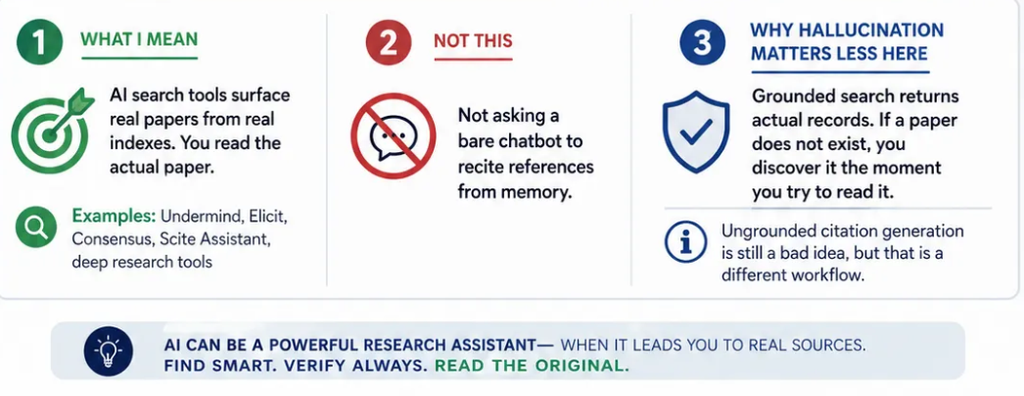
On a related note, people are often concerned about hallucinated citations
I’ve been using Undermind.ai a fair bit over the last few months (have paid for a subscription so not limited in number of searches).
A given Undermind search will produce x number of citations and when I export those into Paperpile, the number is always the same and all the paper titles are on the topic (one example)
This meshes with what I’ve read – Undermind doesn’t hallucinate citations (but sometimes the article metadata can have errors – not a problem if the reference manager can update citations)
Scholar Sidekick formats citations & offers several other tools (scroll down to view). One potentially useful one is citation verification (use the Batch option on the right to verify up to 10 citations at a time)
It has a valuable Citation Integrity page which gives three examples of how citation fabrication can occur, which is an interesting read
The tool provided goes beyond those that just check whether a DOI resolves, which by itself is not sufficient, and so could be a useful to provide increase confidence that citations are genuine.
🐈⬛ 🐕 🐧 🦋 🐁 🐜 🐛
For those using Ovid Discovery, there is now a discussion list you can join
It’s available in the relevant area of the HLA site, along with quite a few others of potential interest
The platform is freelist.org and as the name suggests it’s free and also quite easy to set up and use so you can create your own discussion list if you wish
🐈⬛ 🐕 🐧 🦋 🐁 🐜 🐛
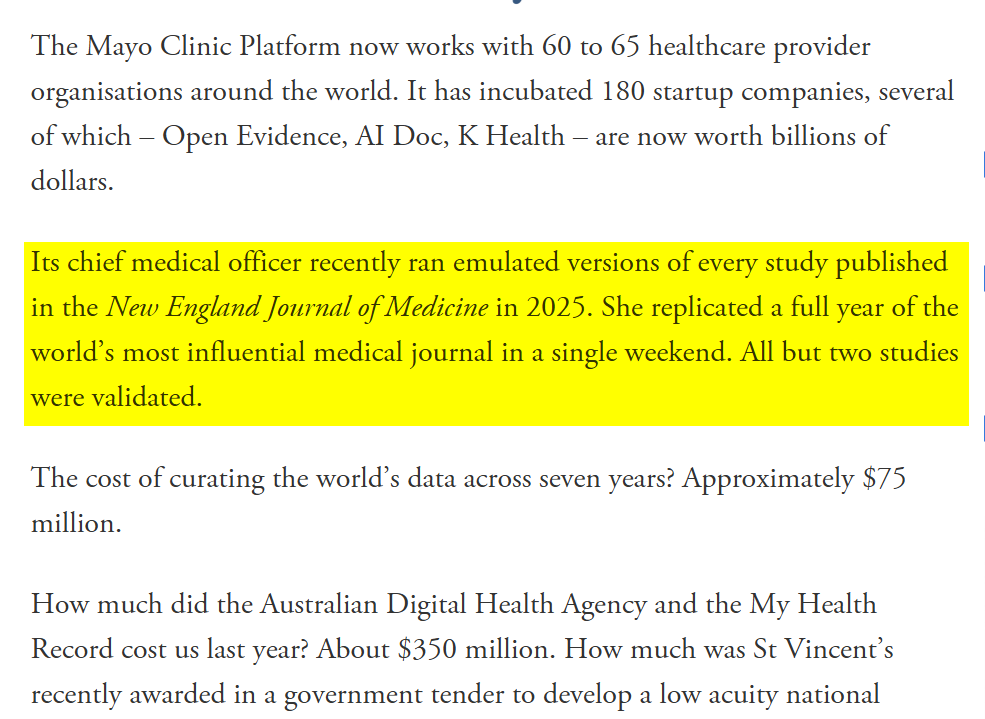
“She replicated a full year of the world’s most influential journal in a single weekend”
“ChatGPT 5.0 … approaching but not matching human performance.”
” AI can substantially reduce the time and labor required”
🐘 Left hand truncation (from the expert searching listserv – mainly added so could use the elephant icon for truncation)
“left-hand truncation is possible in Cochrane Wiley, which can be quite helpful. For example, *glyc*mi* returns multiple spellings, including hypoglycaemia, hyperglycemic, glycaemic, etc”
“MEDLINE through Web of Science makes left truncation possible: *therap* in title: 1,514,613 hits; therap* in title: 1,111,039” “While we cannot left-truncate in Ovid, we can mid-truncate.C*fentan*.ti. for example retrieves cyclopropylfentanyl along with carfentanil, carfentanyl, etc.”
“laptop $500..$800 returns results mentioning prices in that range. The same syntax works for years (civil rights legislation 1964..1968) or any other measurement”
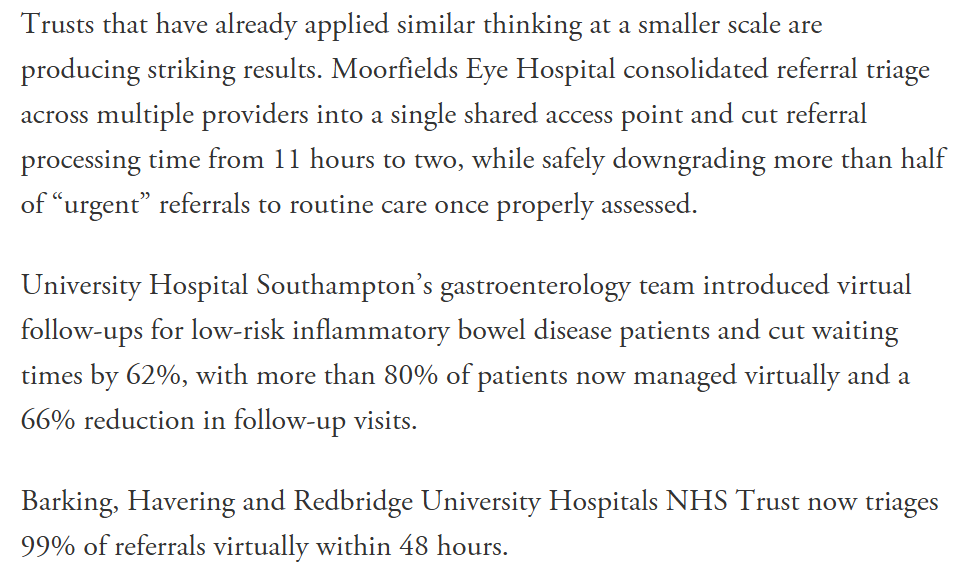
“other agents such Claude Health and Wellness AI are gaining patient traction so fast that the NHS is in a dilemma about how it will manage its comprehensive information triage service – an equivalent idea to 1800Medicare which has been around more than a decade.”
“Wolters Kluwer Health today announced a collaboration with Microsoft that integrates UpToDate®, a leading clinical decision support (CDS) solution, with Microsoft Dragon Copilot, Microsoft 365 Copilot, and Microsoft Teams”
“But no Australian health institution dealing at scale with patients will be able to ignore what Amazon has now shown the new AI agents can do at scale in the UC San Diego Health experiment: EMR linked agentic patient verification, appointment management, patient insights, ambient documentation, and medical coding, all in real time. The UC San Diego Health project, if nothing else, has proven that in days, not months of integration work at a big provider, an AI engagement agent can give patients faster access to care, clinicians more time for care, and release a conga line of related patient facing staff to do other important work.”
An oldie but a goodie. Easy one for health librarians …
A boy is in a terrible car accident. His father is killed at the scene. The boy is rushed to hospital and taken to the operating theatre. The surgeon walks in, looks at him, and says: “I can’t operate on him — he’s my son”?
Changing minds and methods: providing health sciences faculty with alternatives to systematic reviews assignments
Which Systematic Review Software Works Best? A Practical Comparison
good comparison table
bims: Biomed News (other listservs of possible interest to health librarians available on the Elist section of HLA)
how you can create your own alert if you are particularly interested in a topic, and then others can follow it etc
OpenEvidence
Google Vids – New (Sep 2025) / free (10 min length limit), cloud based, seems pretty easy to use / can provide text & a pretty good AI voice will provide the voiceovers / introductory video
“Prism (free) brings together drafting, editing, citation management, equations, and collaboration in a single, cloud-based environment. Built with native LaTeX support, the platform removes the need for complex local setups while enabling researchers to focus on their work rather than tooling”
” … just a few of the tasks assigned to people on RentAHuman.ai — a platform that allows people to advertise their time and talent to artificial-intelligence agents”
Keyboard shortcuts for Outlook (web version) – in case of use to anyone else who prefers the web version of Outlook (may work in the program also – not sure)
(note – this is with Gmail keyboard shortcuts activated via settings (cog icon top right) > General > Accessibility > Keyboard Shortcuts > select Gmail)
Close email – U (takes you back to list view)
Delete email – Shft 3 (ie #)
Expand (conversation) – ;
Folders (move focus to) – Ctrl Y
Forward email – F
Go to Drafts – G D
Go to Inbox – G I
Go to Sent – G T
Junk – Shft 1 (send message to junk)
Keyboard shortcuts – ?
Label – L
Left panel (hide) – Alt F1
Letter navigation – Alt > letter
Mark read – Shift I
Mark unread – Shift U
Move email to folder – V
New email – C
New Window – Shft Enter (new window. Win up arrow for full screen. Useful to see full chain)
Next email in list – J
Open first email – EnterPin – right click and select
Previous email in list – K
Reply – R
Reply all – A
Search – /
Select – X
Send – Ctrl Enter
Snooze – B (set it to reappear)
Search:
category: e.g. category:tickets (via Label as above)
subject: e.g. subject:iron
from: e.g from:juliet
Boolean: e.g. AND OR NOT (e.g. received:12/03/2024 AND subject:ticket)
attachments: e.g. hasattachment:yes attachments:*.docx
received: e.g. received:today “this week” “this month” “this year” 12/03/2024
to: e.g. to:juliet
Many of you may have heard that Cheryl Hamill is exiting stage left (today actually) after many years being a leading light in health librarianship.
Read the poem written for her – by a librarian with clearly too little work to do – and discover her most ardent parting wish …
“One in four animals on the planet earth is a beetle. Think of your three closest friends – if none of them are beetles, statistically speaking you are probably a beetle” 🪲
New issues of JEAHIL, JCHLA (reviews of Lens, DynaMed, OpenAlex etc)
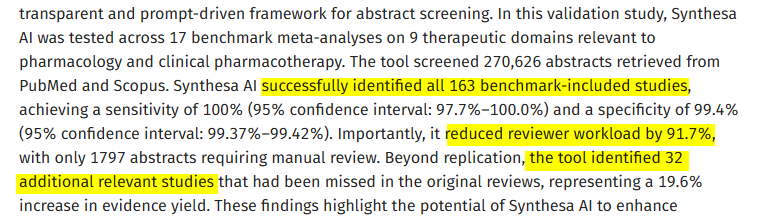
“We recently introduced otto-SR (Otto Science Institute), a generative AI system for automated screening and data extraction that incorporates advanced prompting strategies and agentic LLM workflows. Data from currently unpublished studies involving benchmarking against dual human reviewers suggest that otto-SR achieved superior performance in both screening (otto-SR: 96.7% sensitivity, 97.9% specificity; human: 81.7% sensitivity, 98.1% specificity) and data extraction (otto-SR: 93.1% accuracy; human: 79.7% accuracy) tasks. Most notably, otto-SR reproduced and updated an entire issue of the Cochrane library (12 SRs) in under 2 days*, highlighting the potential for automation to accelerate evidence synthesis and to provide decisionmakers with timely information. Across these 12 SRs, otto-SR included nearly twice as many eligible studies as the original Cochrane authors (114 versus 64 studies)”
* “Using otto-SR, we reproduced and updated an entire issue of Cochrane reviews (n=12) in two days, representing approximately 12 work-years of traditional systematic review work“. From the preprint describing Otto
“More recently, the concept of agentic RAG has gained traction, promising more sophisticated “deep research” capabilities. Systems developed by industry leaders such as OpenAI [16], Perplexity AI [17], and Google [18] have demonstrated the ability to decompose complex questions, perform iterative searches, and synthesize more comprehensive reports. Yet, these general-purpose agentic systems are not specifically tailored for the biomedical domain … to bridge this gap, we introduce Queryome, a multi-agent deep research system designed specifically for end-to-end biomedical literature analysis. Queryome orchestrates a hierarchy of collaborating AI agents that perform iterative, multi-faceted searches against a curated, comprehensive search engine covering the entirety of PubMed [1]. Crucially, the system is engineered to reason over abstract text of every retrieved article, ensuring that its final synthesis is deeply grounded in the available evidence”
Instats videos – quite a few are free (using Filters (top right) > Sort by > Free. Many are quite technical but there are a number on research, using statistical tools (R, Python etc). An upcoming one is AI Tools for Research 2.0 (requires free registration, can be watched later)
Previously mentioned the many useful ebooks available via Open Educational Resources (OER) but difficulty in keeping track on new ebooks available. You can sign up to receive updates here
Spotted in the Fin Review re terrible corporate jargon – being “Promoted Outwards” is “not about job cuts but giving employees the opportunity to embrace new challenges outside the organisation”
Firmly in the “work smarter, not harder” camp – a library’s change from EZProxy to Open Athens resulted in a huge number of dead links. They were fixing these manually one by one, over two years until …. (article title gives it away)