

The latest issue of the Journal of Health Information and Libraries Australasia (JoHILA) includes:
- An interesting, thoughtful, entertaining editorial (The Moon Under Water)
- An insight into the history and applicability of the ELIZA effect
- A clinical psychologist’s journey completing a systematic review, with a little help from an AI research assistant (and a helpful librarian)
- Don Keast’s recollection of 50 things he did promoting a small library (A Paean For Small Libraries)
- A number of personal pieces including a new health librarian’s reflection on her first year (More Questions Than Answers)
And more including – of course – some human-generated AI articles
UpToDate Vs DynaMed Vs BMJ Best Practice Vs ClinicalKey AI, 2026 (Vera Health)
Health Libraries Group HLG Summer Newsletter
Includes an article with links to a free SR online course (example)
Includes an ALIA Health Libraries Australia article by Rolf Schafer
The Radical Act behind your local library (via Daniel McDonald)
Quite interesting between the dog-fights, gin-shops, “money wrung from the reluctant grasp of famishing workmen and workwomen”, “plague spots” and “cause of the spread of disease in all towns through the circulation of the books in infected houses”. Who knew they were so contentious
A critical look at EBSCO’s new user interface for systematic reviewers
Four Quick Charts on AI Implementation in Academic Libraries
Free webinar (Wed Sep 9) – Agentic AI in Practice: From Hospitals to Home Care
One of the authors associated with the company
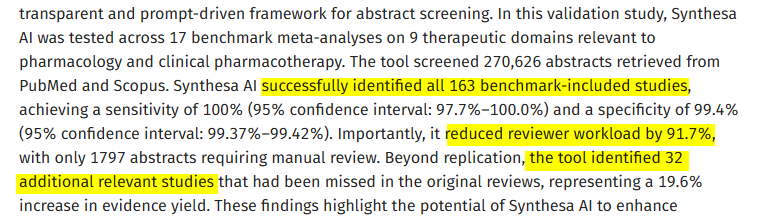
Can This Massive, Free Aggregator Platform Compete with Commercial Giants?
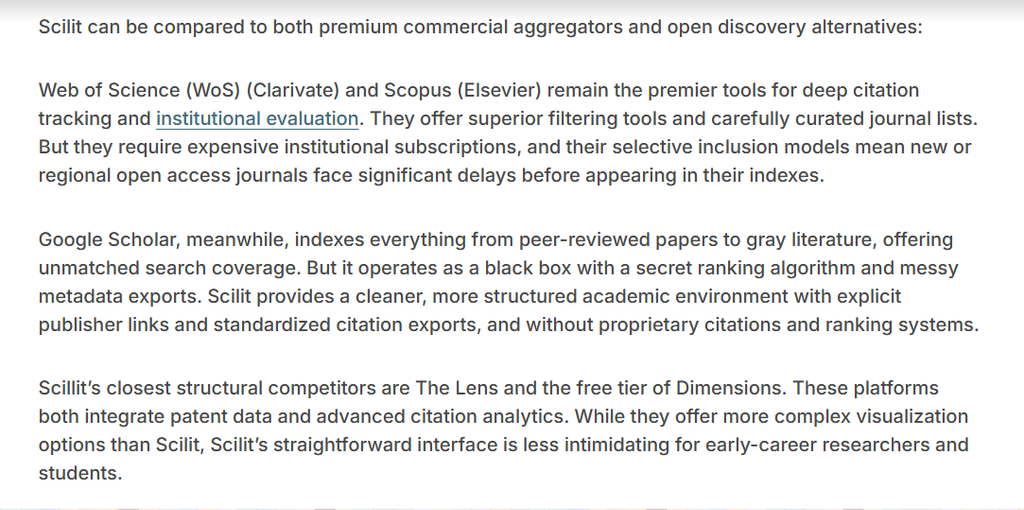
The Human Layer: Why AI Makes Academic Libraries More Essential, Not Less (via Michelle Pitman)
Free NNLM webinar – Greatest Crimes in Statistics (17 Sep)
Mainly included for the title; complements nicely with Statistics for the Terrified
Aaron Tay posts
Hot take: Don’t brainstorm keywords with LLMs. Let them Search
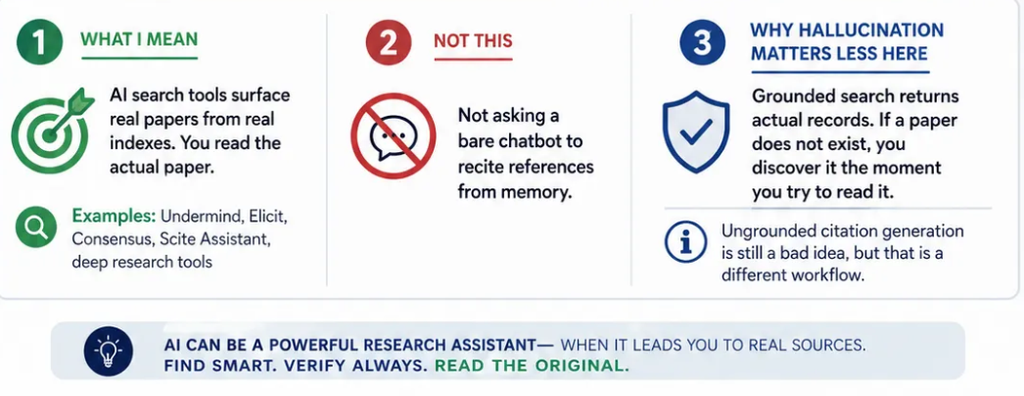
The 11th way is in the article itself (no prizes for guessing it)
👉 NT Health Library authors
New issue of the Journal of the Canadian Health Libraries Association
Reviews on Rayyan.ai, OpenEvidence, GraphicMedicine,
One study tracked their literature review service and found “44% of reference lists did not have a
single click warrants further investigation”
Somewhat disconcerting as almost half, and perhaps suggests that research summaries are useful
additions
”Papers AI brings your writing, data, references and code into the same flow”
Can an AI-Integrated Platform Improve Literature Review? Depends on the Researcher
Review of Moara.io
Health Literacy: The Expanding Role of NHS Knowledge and Library Specialists
In case you missed it. Gratisnet can now autopopulate citation details for article requests – just
paste in the DOI in the DOI field and then tab away – works for all articles that are in doi.org
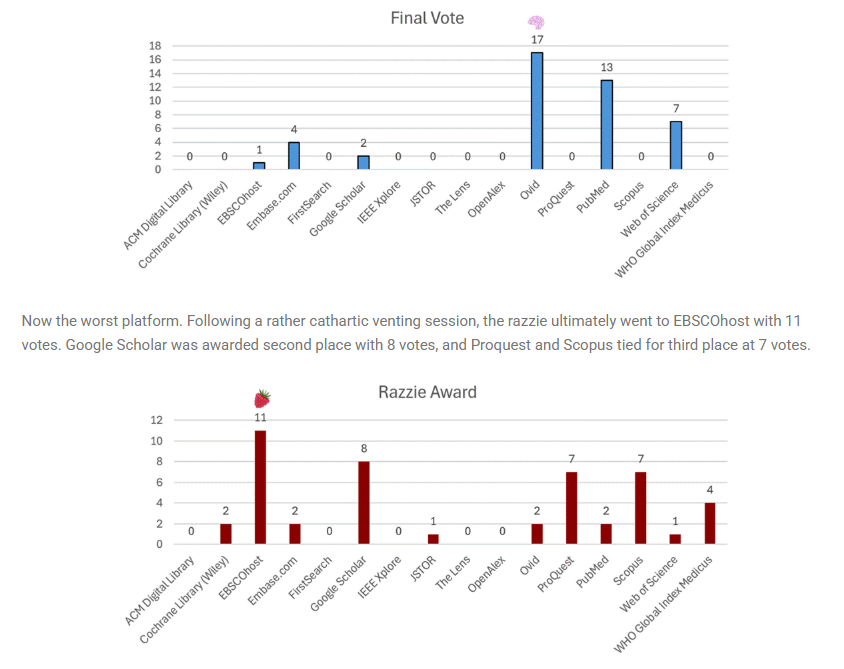
Building a (Database) Creature with the Best Features: An Unscientific Report
Towards autonomous medical artificial intelligence agents
“Compared with previous LLM applications that addressed isolated subtasks or provided free-text advice, these results suggest that an EHR-integrated artificial intelligence agent can turn clinical intent into structured, actionable EHR operations, possibly making it a more effective decision-support partner for physicians”
Tool flags suspicious journals before researchers submit papers
“The free platform, called Journal Trends, could also allow integrity sleuths to spot low-quality
publications”
For Health Science Researchers Navigating Publication, Is a Free Tool Good Enough?
”Scholarly Publishing Information Hub (SPI-Hub) lacks some features of competitor products. But
it’s focused, simple to use, and openly available.”
“in the 2nd experiment, they didn’t even realize that the treatment was completely ineffective”
New issue of JMLA
Automated indexing in MEDLINE and the Medical Text Indexer (MTI), 2000–2025
Scroll down on home page & around twelve health library journals are listed (right hand side)
For those who use RSS (I like Inoreader), you can follow JoHILA this way (again right side)
5 ways libraries can support researchers in the ai era (Elsevier)
Beyond Belief: How Evidence Shows What Really Works (Book Review)
Possibly a good one for the collection
Our biggest AI problem: agentic AI, one hospital at a time
HealthTalk (sites that have videos of patients, carers etc discussing what it’s really like to live with a particular condition)
HealthTalk International seems to have disappeared & replaced with Health Experience Insights
HealthTalk Australia still going (focus on mental health, women’s health, ageing etc)
Both sites above probably useful for any health literacy / consumer information pages you have
If interested in health literacy, a new elist – Librarians Advancing Health Literacy Other Listservs)
Ovid Discovery elist now available – can subscribe here
Uses Freelists so you can set up your own elist quite easily if you want
”A General-Purpose Biomedical AI Agent”
”… with 150 specialized tools, 59 databases, and 105 software to automate”
”Biomni is proudly open source”
How NIH Is Translating 70 Years of Health Data To Speak the Same Language
”A cross-agency effort to harmonize 12 petabytes of biomedical data is laying the groundwork for
AI-driven health research at the National
Institutes of Health”
Scholar Labs update: Search 10x faster, 3x deeper
Hot take: Learning from Google Scholar and why a tool does not need to be flawless to be useful
”What 2004 can teach us about 2024 — and the librarians who keep getting the lesson wrong”
General-purpose large language models outperform specialized clinical AI tools on medical benchmarks
Search* Gone Wild! Popular Database Platform* and Their Wildcard*
Newslet AI for libraries weekly newsletter
Recently I had to do a search to see if a particular tool had been validated for use in nursing / midwifery settings
I did a thorough search using several databases as well as looking at all the articles citing the original paper in question
In the end, I was quite confident that the tool hadn’t been used in these settings (which is what the researcher was hoping to hear as they want to validate it for those settings)
Out of interest, I thought I’d put the same question to several AI’s (largely dictated by the ones that haven’t been blocked at work & those that offer a free tier search)
I wasn’t expecting that much as the original paper had been cited around 150 times and many of the articles contained words or phrases related to validation (“we used a validated instrument” etc) as well as being used in nursing and midwifery settings (but not validated for such use) so that you could imagine the AI’s would quite easily be misled & discombobulated, and so conflate this to mean that it had actually been validated in those settings.
The simple question used with each AI tool was:
The Research Capacity and Culture (RCC) tool was developed in 2012 (DOI: 10.1071/PY10081). Are there any articles which subsequently describe specifically validating this RCC tool for use with nurses or midwives?
Rather to my surprise, I found that not one of the eight AI’s made this error, and all correctly concluded that it hadn’t been validated in those settings (Undermind did identify one study where some partial psychometric validation had been performed – key summary report here)
Platforms tested included:
Undermind, Elicit, EvidenceHunt, Doximity, Consensus, Scholara, Genspark & scienceOS.
So overall, I was quite impressed by their performance. Of course, this was one search & a long, long way from a proper evaluation
(Later on I asked the same question of Copilot and it also gave the correct answer and suspiciously quickly. Perhaps it had been eavesdropping on the others …)
🐈⬛ 🐕 🐧 🦋 🐁 🐜 🐛
On a related note, people are often concerned about hallucinated citations
I’ve been using Undermind.ai a fair bit over the last few months (have paid for a subscription so not limited in number of searches).
A given Undermind search will produce x number of citations and when I export those into Paperpile, the number is always the same and all the paper titles are on the topic (one example)
This meshes with what I’ve read – Undermind doesn’t hallucinate citations (but sometimes the article metadata can have errors – not a problem if the reference manager can update citations)
Scholar Sidekick formats citations & offers several other tools (scroll down to view). One potentially useful one is citation verification (use the Batch option on the right to verify up to 10 citations at a time)
It has a valuable Citation Integrity page which gives three examples of how citation fabrication can occur, which is an interesting read
The tool provided goes beyond those that just check whether a DOI resolves, which by itself is not sufficient, and so could be a useful to provide increase confidence that citations are genuine.
🐈⬛ 🐕 🐧 🦋 🐁 🐜 🐛
For those using Ovid Discovery, there is now a discussion list you can join
It’s available in the relevant area of the HLA site, along with quite a few others of potential interest
The platform is freelist.org and as the name suggests it’s free and also quite easy to set up and use so you can create your own discussion list if you wish
🐈⬛ 🐕 🐧 🦋 🐁 🐜 🐛
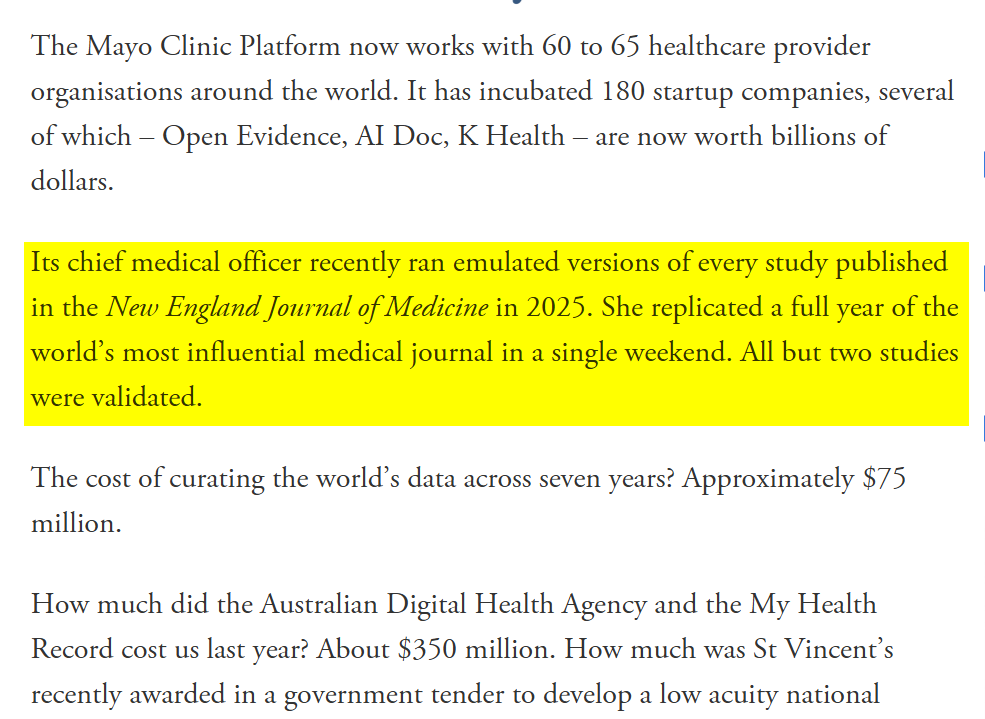
“She replicated a full year of the world’s most influential journal in a single weekend”
Source: https://www.healthservicesdaily.com.au/ai-and-data-slow-has-a-body-count/47535
- Useful collection of citations tools, including:
- Format a citation
- Extract unique ID’s (DOI, PMID) from a block of pasted text
- DOI to RIS
- Verify DOI
- Retraction checker
- Identifier Validator (confirm a real publication rather than an AI hallucination)
- & a number more
“Can a chatbot be used in the full-text screening in a systematic review?”
- “ChatGPT 5.0 … approaching but not matching human performance.”
- ” AI can substantially reduce the time and labor required”
🐘 Left hand truncation (from the expert searching listserv – mainly added so could use the elephant icon for truncation)
- “left-hand truncation is possible in Cochrane Wiley, which can be quite helpful. For example, *glyc*mi* returns multiple spellings, including hypoglycaemia, hyperglycemic, glycaemic, etc”
- “MEDLINE through Web of Science makes left truncation possible: *therap* in title: 1,514,613 hits; therap* in title: 1,111,039”
“While we cannot left-truncate in Ovid, we can mid-truncate.C*fentan*.ti. for example retrieves cyclopropylfentanyl along with carfentanil, carfentanyl, etc.”
Latest issue of JMLA
- Comparing five generative AI chatbots’ answers to LLM-generated clinical questions with medical information scientists’ evidence summaries
- Comparing the performance of narrow vs. broad search strategies when using machine learning-based software for title/abstract screening
- Enhancing patient care: the power of librarian-mediated literature reviews (look for the 💎)
- Expert-recommended tasks for hospital librarians during a healthcare system merger or acquisition
Latest issue of JoHILA
- Leadership roles and competencies of Australian health sciences library leaders
- Demonstrating value by measuring your success: the power of an audit
- Health and Wellbeing Spaces in Health Libraries
Tip#66: Searching for author names in PubMed (an overview, headaches, and an Excel shortcut!)
Redesigned Research Rabbit (7 min video)
The 2026 AI Index Report (definitely worth a quick scroll through)
Library Skills “Free resources to help library staff level up and learn new skills”
Google has a secret reference desk – here’s how to use it
- “Try: climate AROUND(3) policy”
- “laptop $500..$800 returns results mentioning prices in that range. The same syntax works for years (civil rights legislation 1964..1968) or any other measurement”
- “mental health social media research after:2023”
AI in practice: trends in hospital and clinic libraries, 2026
Fabricated citations: an audit across 2.5 million biomedical papers
”An analysis of 97 million references has found that rates of fabricated citations have climbed steeply since 2023″
🔎 Windows File Explorer keyboard shortcuts (most useful at the top)
Address bar Ctrl L (search by typing, arrow down to select)
Open Win E
Search Ctrl F (good for internal strings, else Address etc)
Sidebar (focus) Shift Tab (good for moving to folders list from files list)
Sidebar (unfocus) Tab (good for moving to files list from folders list)
Forward / Back Alt right / left arrow
Full screen F11
New Folder Ctrl Shft N
New Window Ctrl N
Parent (folder) Alt Up Arrow
Preview (file) Alt P
Properties (file) Alt Enter
Rename F2
Tab (switch) Ctrl Tab (same as browser)
Tab (new) Ctrl T
Best Search Engines for Research Papers in 2026
- video / 9 tools ranked including a number of ai ones
What Happens When AI Can Use the Library
- discusses MCP which is an approach that lets AI agents more easily navigate sites, platforms etc. Probably coming to an LMS near you
Yale Library is testing an AI-powered connection for deeper searching of library resources
- another MCP example
Why Swedish Schools Are Bringing Back Books
How Australia Built a Standards-Based National Lending Network
What’s a library worth? Report puts dollar figure on ‘invaluable’ institutions
Automate your library’s e-resource access testing (compatible with EZProxy & OpenAthens)
Systematic reviews in minutes to hours
- Scholara tool used is free to try
Libraries 2045: What Will the Next 20 Years of Libraries and AI Look Like?
Health Sciences Library Group 2026 Conference presentations
Horizon Europe decision: ‘benefits for decades’, say unis
- closer ties between European and Australian research
Search String Theory – Applying pairwise combinatorics to PubMed searches
- “tool designed to streamline the creation of complex PubMed search strings”
From hospital-by-default to neighbourhood-by-design
Goodbye 1800Medicare: it was brief, but nice knowing you
- “other agents such Claude Health and Wellness AI are gaining patient traction so fast that the NHS is in a dilemma about how it will manage its comprehensive information triage service – an equivalent idea to 1800Medicare which has been around more than a decade.”
- “Wolters Kluwer Health today announced a collaboration with Microsoft that integrates UpToDate®, a leading clinical decision support (CDS) solution, with Microsoft Dragon Copilot, Microsoft 365 Copilot, and Microsoft Teams”
Healthdirect signals major shift: ‘front end has changed; the mission has not’
- Healthdirect considering how it can make it’s content appear in Google AI snippets more effectively
Genomics and Your Hospital : A toolkit to support hospitals implement high-quality genomic care
New AI agents and referral platforms might rewire Australian healthcare by stealth
- “But no Australian health institution dealing at scale with patients will be able to ignore what Amazon has now shown the new AI agents can do at scale in the UC San Diego Health experiment: EMR linked agentic patient verification, appointment management, patient insights, ambient documentation, and medical coding, all in real time. The UC San Diego Health project, if nothing else, has proven that in days, not months of integration work at a big provider, an AI engagement agent can give patients faster access to care, clinicians more time for care, and release a conga line of related patient facing staff to do other important work.”
An oldie but a goodie. Easy one for health librarians …
A boy is in a terrible car accident. His father is killed at the scene. The boy is rushed to hospital and taken to the operating theatre. The surgeon walks in, looks at him, and says: “I can’t operate on him — he’s my son”?
Academic medical librarians and video consultations: our new normal (2026)
Collaborative large language models (LLMs) are all you need for screening in systematic reviews (2026, preprint)
”collaborative approach utilizing the two best-performing models (GPT-4 & Claude-3S) achieved an average precision of 99.9% & recall of
98.5%”
AI, Automation, and the Future of Library Science Degree Careers (2026)
Thousands of paywalled research papers could be freed with this simple fix (2026, JCU librarians)
Latest issue of JMLA
Changing minds and methods: providing health sciences faculty with alternatives to systematic reviews assignments
Which Systematic Review Software Works Best? A Practical Comparison
good comparison table
bims: Biomed News (other listservs of possible interest to health librarians available on the Elist section of HLA)
how you can create your own alert if you are particularly interested in a topic, and then others can follow it etc
OpenEvidence
Google Vids – New (Sep 2025) / free (10 min length limit), cloud based, seems pretty easy to use / can provide text & a pretty good AI voice will provide the voiceovers / introductory video
Canadian Health Library Value Planner (2026) – available at Health Libraries – How to Demonstrate Value
Google Scholar title OR search
allintitle:dog | cat | “insulin resistance”
OpenAi launches Prism for researchers
“Prism (free) brings together drafting, editing, citation management, equations, and collaboration in a single, cloud-based environment. Built with native LaTeX support, the platform removes the need for complex local setups while enabling researchers to focus on their work rather than tooling”
AI agents are hiring human ‘meatspace workers’ — including some scientists (2026)
” … just a few of the tasks assigned to people on RentAHuman.ai — a platform that allows people to advertise their time and talent to artificial-intelligence agents”
Open-source AI tool beats giant LLMs in literature reviews — and gets citations right (2026)
Australia introduces open science policy to expand access and collaboration in health research (2026, old news but comes into effect Jan & Feb for MRFF & NHMRC respectively)
Are AI Tools Killing Review Articles? Two Failure Modes Suggest Otherwise (2026, Aaron Tay)
Keyboard shortcuts for Outlook (web version) – in case of use to anyone else who prefers the web version of Outlook (may work in the program also – not sure)
(note – this is with Gmail keyboard shortcuts activated via settings (cog icon top right) > General > Accessibility > Keyboard Shortcuts > select Gmail)
| Close email – U (takes you back to list view) |
| Delete email – Shft 3 (ie #) |
| Expand (conversation) – ; |
| Folders (move focus to) – Ctrl Y |
| Forward email – F |
| Go to Drafts – G D |
| Go to Inbox – G I |
| Go to Sent – G T |
| Junk – Shft 1 (send message to junk) |
| Keyboard shortcuts – ? |
| Label – L |
| Left panel (hide) – Alt F1 |
| Letter navigation – Alt > letter |
| Mark read – Shift I |
| Mark unread – Shift U |
| Move email to folder – V |
| New email – C |
| New Window – Shft Enter (new window. Win up arrow for full screen. Useful to see full chain) |
| Next email in list – J |
| Open first email – EnterPin – right click and select |
| Previous email in list – K |
| Reply – R |
| Reply all – A |
| Search – / |
| Select – X |
| Send – Ctrl Enter |
| Snooze – B (set it to reappear) |
Search:
category: e.g. category:tickets (via Label as above)
subject: e.g. subject:iron
from: e.g from:juliet
Boolean: e.g. AND OR NOT (e.g. received:12/03/2024 AND subject:ticket)
attachments: e.g. hasattachment:yes attachments:*.docx
received: e.g. received:today “this week” “this month” “this year” 12/03/2024
to: e.g. to:juliet
Many of you may have heard that Cheryl Hamill is exiting stage left (today actually) after many years being a leading light in health librarianship.
Read the poem written for her – by a librarian with clearly too little work to do – and discover her most ardent parting wish …
“One in four animals on the planet earth is a beetle. Think of your three closest friends – if none of them are beetles, statistically speaking you are probably a beetle” 🪲
New issues of JEAHIL, JCHLA (reviews of Lens, DynaMed, OpenAlex etc)
New Aaron Tay posts:
The Blank Box Problem: Why It’s Harder Than Ever to Know What to Type Into an AI Search Bar
Deep Research, Shallow Agency: What Academic Deep Research Can and Can’t Do
Google Scholar Labs (ask it a natural language question and it provides a set of citations with each having a summary of the answer underneath it)
Google Scholar blog (highlights and comments now available in Scholar PDF Reader)
Interesting read – Technically Accurate, Medically Fatal : The AI Error We Caught in Real-Time
Very extensive wiki on AI compiled by a medical librarian (Dean Guistini). Scroll down to see the most visited topics, review on individual tools
Conducting Systematic Reviews in a Day: Enter Artificial Intelligence (one of the authors is from the Centre for Journalology so must be good)
“We recently introduced otto-SR (Otto Science Institute), a generative AI system for automated screening and data extraction that incorporates advanced prompting strategies and agentic LLM workflows. Data from currently unpublished studies involving benchmarking against dual human reviewers suggest that otto-SR achieved superior performance in both screening (otto-SR: 96.7% sensitivity, 97.9% specificity; human: 81.7% sensitivity, 98.1% specificity) and data extraction (otto-SR: 93.1% accuracy; human: 79.7% accuracy) tasks. Most notably, otto-SR reproduced and updated an entire issue of the Cochrane library (12 SRs) in under 2 days*, highlighting the potential for automation to accelerate evidence synthesis and to provide decisionmakers with timely information. Across these 12 SRs, otto-SR included nearly twice as many eligible studies as the original Cochrane authors (114 versus 64 studies)”
* “Using otto-SR, we reproduced and updated an entire issue of Cochrane reviews (n=12) in two days, representing approximately 12 work-years of traditional systematic review work“. From the preprint describing Otto
Queryome: Orchestrating Retrieval, Reasoning, and Synthesis across Biomedical Literature
“More recently, the concept of agentic RAG has gained traction, promising more sophisticated “deep research” capabilities. Systems developed by industry leaders such as OpenAI [16], Perplexity AI [17], and Google [18] have demonstrated the ability to decompose complex questions, perform iterative searches, and synthesize more comprehensive reports. Yet, these general-purpose agentic systems are not specifically tailored for the biomedical domain … to bridge this gap, we introduce Queryome, a multi-agent deep research system designed specifically for end-to-end biomedical literature analysis. Queryome orchestrates a hierarchy of collaborating AI agents that perform iterative, multi-faceted searches against a curated, comprehensive search engine covering the entirety of PubMed [1]. Crucially, the system is engineered to reason over abstract text of every retrieved article, ensuring that its final synthesis is deeply grounded in the available evidence”
Available as an app for Windows & MacOS
Instats videos – quite a few are free (using Filters (top right) > Sort by > Free. Many are quite technical but there are a number on research, using statistical tools (R, Python etc). An upcoming one is AI Tools for Research 2.0 (requires free registration, can be watched later)
Previously mentioned the many useful ebooks available via Open Educational Resources (OER) but difficulty in keeping track on new ebooks available. You can sign up to receive updates here
Spotted in the Fin Review re terrible corporate jargon – being “Promoted Outwards” is “not about job cuts but giving employees the opportunity to embrace new challenges outside the organisation”
TRIP Mind Maps live / Video introduction
The second round of the MLA UX Caucus Lightning Talks are now available on the HLA Videos page
A number of Ovid / PubMed search-related presentations which could be of interest
(Underneath this is the TERA overview by Justin Clark – worth a watch if haven’t seen it yet)
Speaking of MLA, they have quite a few free PD courses available (potentially useful for the Health Professional Development Scheme, or just to become more librarianish)
Firmly in the “work smarter, not harder” camp – a library’s change from EZProxy to Open Athens resulted in a huge number of dead links. They were fixing these manually one by one, over two years until …. (article title gives it away)