While the internet provides considerable opportunities to access and share information, it also increases people’s exposure to misinformation. It is increasingly difficult to determine the trustworthiness of the media in our environment, which is of particular concern in the field of health. Evidence suggests health misinformation is having real-world widespread negative consequences.
This talk explores how a media literacy approach can help organisations, community groups and citizens respond to the challenge that misinformation poses. It draws on findings from a 3-year research study that partnered with four public cultural institutions: Australian Library and Information Association, ABC Education, Museum of Australia Democracy and the National Film and Sound Archive of Australia.
Presenters
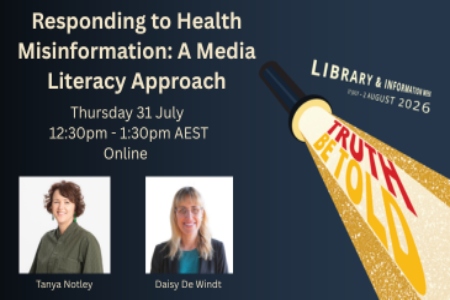
Tanya Notley & Daisy De Windt
Bios
Tanya Notley is Professor of Digital Media in the School of Arts and a member of the Institute for Culture and Society. Tanya currently leads a national project that uses media literacy to address online misinformation through a collaboration with national public cultural institutions. Tanya leads the Advancing Media Literacy Program at WSU and is a founding member of Australian Media Literacy Alliance (AMLA).
Daisy De Windt has over 20 years’ experience working in research, medical education and health communications, including over 10 years producing engaging, evidence-based media for a range of audiences. She has completed degrees in Psychology, Health Law, Biomedical Science and Business and is a PhD candidate at Western Sydney University.
When
Thursday, 30 July 2026 12:30pm – 1:30pm AEST
Where
Online webinar Zoom – a link will be sent the day prior.
This event will be recorded and sent to attendees following the event.
Cost
ALIA Members – FREE (another reason to consider HLA Membership) Non-Members – $22
Human participant research sits at the uncomfortable intersection of good intentions, regulation, and paperwork — and it applies to far more projects than most people realise. This session provides a practical, big picture overview of what counts as human participant research, and why interventional research is only a subset of that, why “clinical trial” is not synonymous with “medical experiment,” and how projects move from idea to ethics and governance approval to actual participants. Framed specifically for health library professionals, Sarah will explore where library services can add real value across the research lifecycle, from shaping research questions and evidence bases through to protocols, data management, consent, and publication — and why working closely with local research offices makes all of this easier for everyone involved.
In her previous life, Sarah worked in a wide variety of roles in the Health and Medical research field over 15 years, with the majority of her experience in Ethics and Governance (both as a submitter and an approver), before a recent career change to librarianship! Currently she works as the Clinical Research and Education Librarian at Eastern Health.
She has a passion for both human participant research, for exploring innovative ways to deliver education and training, and for getting the right information to the right people at the right time – which is why she’s presenting here!
She loves dogs 🐶, but does not have one yet, so encourages you to tell her about your pets.
✅ ALIA HLA Competencies
CA1 – The health environment CA7 – Health research View HLA Competencies
This survey – held once every three years – is now open and closes 14th June
Visit the site for more information and to complete the survey
Doing so helps increase the visibility of health librarians …
Why it is important for health librarians to be included in a Specialist Digital Health Workforce Census
Including health librarians in a specialist digital health workforce census is critical because it makes visible a workforce that is central to safe, effective, and evidence‑informed digital health systems. Health librarians work at the intersection of clinical care, research, information governance, digital literacy, and health informatics. When we are excluded from workforce data collections, our contributions are rendered invisible to policymakers, funders, and senior health administrators.
A digital health workforce census can be used to:
map current workforce capability
identify skills gaps and future needs
inform funding, workforce planning, and training priorities
demonstrate workforce impact on health system outcomes
If librarians are not counted, the data inevitably underrepresents the true breadth of specialist digital health expertise within hospitals and health services. This can lead to:
underinvestment in library and knowledge services
assumptions that digital health skills sit only with IT or clinical informatics roles
missed opportunities to leverage librarians’ expertise in areas such as evidence synthesis, data quality, AI governance, and digital capability building
Inclusion in the census formally recognises health librarians as part of the digital health ecosystem rather than as an “optional support service”.